COMMERCIAL & BUSINESS LAW
Business Structures in Australia: Company, Trust, Partnership or Sole Trader?
Choosing a business structure is one of the first important decisions when starting or acquiring a business. The structure you choose can affect control, personal liability, taxation, administration, bringing in new owners and eventually selling or transferring the business.
By Katie Chan
There is no single business structure that is right for everyone.
A sole trader structure may be appropriate for a relatively straightforward owner-operated business, while another business may benefit from operating through a company, partnership or trust.
The Australian Government identifies sole trader, partnership, company and trust as four common business structures and notes that the choice can affect taxation, personal liability, control, ongoing costs and administration.
The appropriate structure should therefore be considered in light of both where the business is today and where its owners expect it to go.
Why Does Your Business Structure Matter?
Your structure determines the legal framework through which the business operates.
Depending on the structure, it can affect:
- who legally owns business assets;
- who enters contracts;
- who is responsible for business debts;
- how decisions are made;
- taxation;
- how profits are distributed;
- whether additional owners or investors can be introduced;
- ongoing reporting and compliance;
- succession planning; and
- how the business can eventually be sold or transferred.
It can be possible to change structures later, but restructuring may require new registrations, transfers of assets and licences and consideration of legal and taxation consequences.
For that reason, it is worth considering the structure carefully at the beginning.
1. Sole Trader
A sole trader is an individual operating a business in their own capacity.
It is generally the simplest of the common business structures.
The owner controls the business and is legally responsible for its operations, including its debts and losses. The Australian Government describes a sole trader as having unlimited liability, meaning personal assets can potentially be exposed if things go wrong.
Advantages of operating as a sole trader
A sole trader structure can offer:
- relatively simple establishment;
- lower establishment and administration costs;
- fewer reporting requirements;
- direct control over business decisions; and
- a straightforward ownership structure.
For a person starting a relatively small business on their own, that simplicity can be attractive.
Issues to consider
The significant distinction is that there is no separate company standing between the individual and the business.
The individual is responsible for the business's liabilities.
It can also become less convenient if the business grows and the owner later wants to introduce investors or additional owners.
A sole trader may therefore eventually reconsider the structure as the business expands.
2. Partnership
A partnership generally involves two or more people carrying on a business together and sharing its income or losses.
Partnership laws are state and territory based. In Queensland, partnerships are principally governed by the Partnership Act 1891 (Qld).
The Australian Government notes that in a general partnership, the partners manage the business and have unlimited liability for partnership debts and obligations.
Why use a partnership?
A partnership can be relatively straightforward to establish and may suit two or more people who want to operate a business together without establishing a company.
However, entering business with another person creates additional issues that do not arise for a sole trader.
Those issues include:
- who contributes the initial capital;
- how profits and losses are divided;
- who can make decisions;
- what each partner's role will be;
- whether partners can incur liabilities on behalf of the business;
- what happens if more funding is required;
- what happens if a partner wants to leave;
- what happens if a partner dies or becomes incapacitated; and
- how the business will be valued if the relationship ends.
A Partnership Agreement Is Important
Business partners should consider documenting their arrangements in a written partnership agreement.
The Australian Government specifically recommends creating a partnership agreement when moving into a partnership structure, including documenting how the partnership will operate and dealing with relevant intellectual property and agreed terms.
Depending on the business, a partnership agreement might address:
- ownership percentages;
- initial contributions;
- future funding;
- drawings;
- profit distributions;
- decision-making;
- responsibilities of each partner;
- banking arrangements;
- intellectual property;
- confidentiality;
- restraints;
- admission of new partners;
- retirement or exit;
- valuation;
- death or incapacity; and
- dissolution of the partnership.
Relying simply on the fact that the owners know and trust one another can leave important questions unanswered.
The best time to establish those rules is usually when the relationship is working well.
3. Company
A company is fundamentally different from a sole trader structure.
Once registered, the company is a separate legal entity from its shareholders and directors. It can own property, enter contracts, incur debts and sue or be sued in its own name.
This distinction is one of the main reasons companies are commonly used for operating businesses.
Who owns and controls a company?
There are two important roles:
Shareholders own shares in the company.
Directors are responsible for managing or directing the company's business.
In a small business, the same person may be both sole shareholder and sole director.
In a larger privately owned business, there may be several shareholders and directors with different ownership percentages and responsibilities.
Limited Liability Does Not Mean No Personal Liability
One of the advantages associated with a company is that shareholders generally have limited liability in their capacity as members.
However, incorporating a company does not mean directors can never be personally liable.
ASIC warns that directors can face personal consequences in various circumstances, including breaches of their legal duties and insolvent trading.
Directors have significant statutory responsibilities and need to understand those obligations rather than regarding a company as an automatic liability shield.
Personal guarantees can also create personal exposure. For example, a bank, landlord or supplier may require a director to personally guarantee a company's obligations.
Companies Have Greater Administration and Compliance
A company is generally more complex to establish and operate than a sole trader business.
Companies have ongoing obligations under the Corporations Act 2001 (Cth) and ASIC requirements.
These can include maintaining records, keeping company information current, completing annual review requirements and paying applicable ASIC fees. Directors also have legal responsibilities concerning the company's affairs and financial position.
That additional administration needs to be weighed against the benefits of the structure.
Companies Can Make Multiple Ownership Easier to Document
One significant advantage of a company structure is the ability to divide ownership through shares.
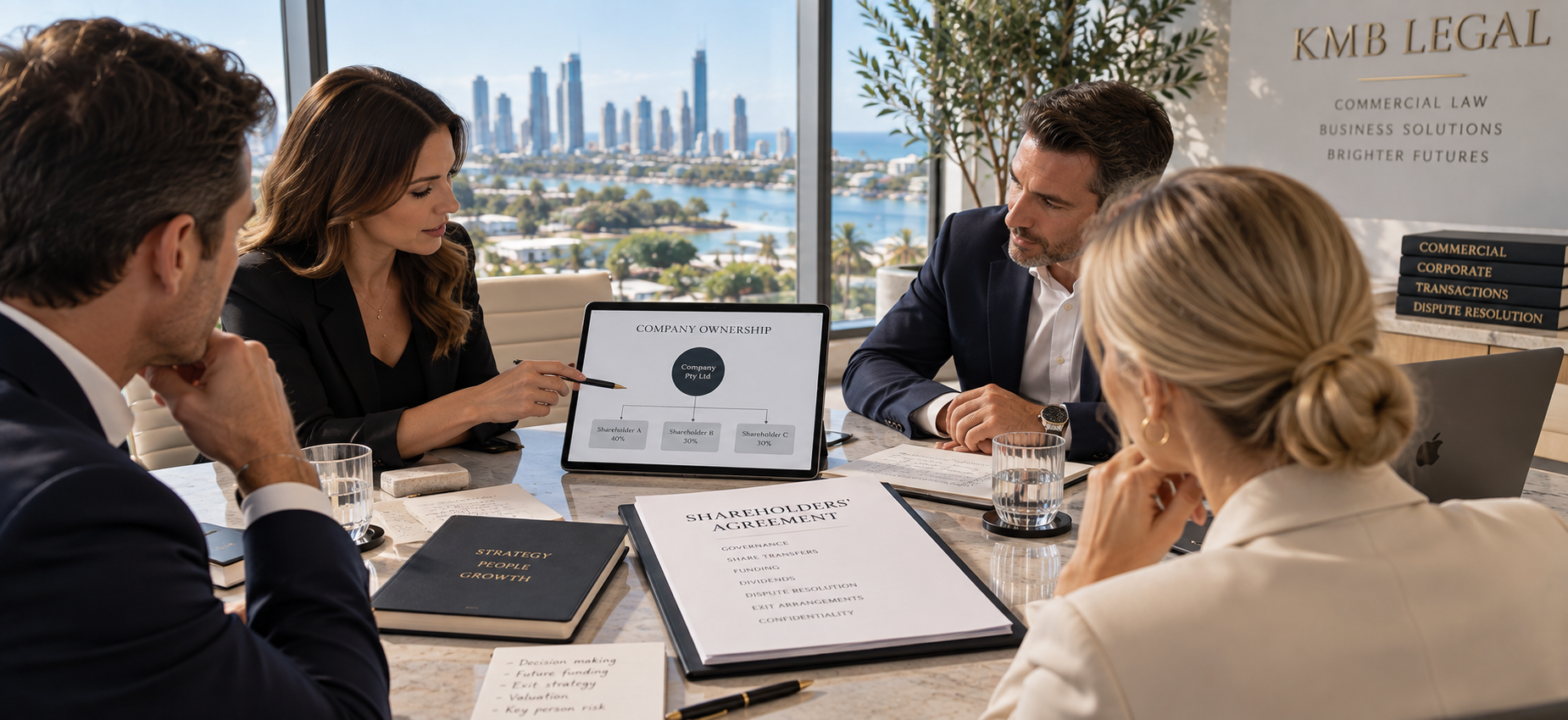
For example, three founders might own:
- Shareholder A — 50%;
- Shareholder B — 30%; and
- Shareholder C — 20%.
Different arrangements are possible depending on the company's constitution and share structure.
Where a company has multiple owners, it is also important to consider a shareholders’ agreement.
That agreement can establish rules concerning decision-making, funding, share transfers, new investors, exits, valuation, deadlocks and the eventual sale of the company.
Related article: Shareholders’ Agreements: Why Every Business With Multiple Owners Should Have One.
4. Trust
A trust is different again.
In a trust structure, a trustee holds and manages property for the benefit of beneficiaries in accordance with the trust deed and applicable law.
The trustee can be an individual or a company.
Unlike a company, a trust is not simply another type of corporation.
The trustee is the person or company that legally conducts the business in its capacity as trustee.
What Is a Corporate Trustee?
Instead of appointing an individual as trustee, a trust may have a company acting as its trustee.
This is commonly called a corporate trustee.
For example:
ABC Holdings Pty Ltd as trustee for the ABC Family Trust
In that scenario, the company acts as trustee and conducts relevant activities in that capacity.
Using a corporate trustee can create advantages in areas such as administration, succession and liability management, depending on the circumstances.
However, the arrangement also creates additional complexity because both the company and trust need to be properly established and administered.
What Is a Discretionary or Family Trust?
A commonly encountered private-business structure is a discretionary trust, often described as a family trust where used within a family group.
Under a discretionary trust, the trustee generally has powers under the trust deed concerning distributions among eligible beneficiaries.
The precise rights and obligations depend heavily upon the terms of the trust deed.
That makes the deed an important document.
Business.gov.au notes that trust structures require a formal trust deed and are generally more complex and expensive to establish and administer than simpler structures.
A Trust Is Not Automatically the Best Structure for Asset Protection
Trusts are frequently discussed in connection with asset protection.
However, simply establishing a trust does not guarantee that every asset is protected from every potential claim.
The outcome can depend on matters including:
- who the trustee is;
- who owns the relevant asset;
- guarantees;
- financing arrangements;
- how the trust has been administered;
- the terms of the trust deed;
- insolvency law; and
- the nature of any claim.
Asset protection should therefore be considered as part of the overall legal and financial structure rather than relying on the label “family trust”.
Company vs Trust: They Are Not Necessarily Alternatives
People sometimes ask whether they should operate through a company or a trust as though only one can be chosen.
In practice, the structures can be combined.
For example:
Operating company
The business may trade through a company owned by shareholders.
Trust with corporate trustee
A company may act as trustee of a discretionary trust through which a business is conducted.
Shares held by a trust
Shares in an operating company may themselves be held by a trustee on behalf of a trust.
There are many possible structures.
The appropriate arrangement depends upon the business owners' objectives and requires legal and taxation advice tailored to their circumstances.
How Do the Four Structures Compare?
At a high level:
Sole trader
- Individual operates business personally
- Individual Owner personally responsible
Partnership
- Two or more persons operate together
- General partners generally have unlimited liability
Company
- Separate legal entity;
- Members generally have limited liability, subject to important exceptions
Trust
- Trustee holds/operates for beneficiaries;
- Trustee acts under trust deed;
- Liablity depends significantly on trustee and structure
These are broad distinctions only. The legal, taxation and financial consequences need to be considered for the particular business.
Which Structure Provides the Best Asset Protection?
There is no universal answer.
A sole trader has direct personal exposure to business liabilities.
A company creates a separate legal entity and generally limits shareholder liability, but directors can still have personal exposure in particular circumstances and personal guarantees may significantly alter the position.
Trust structures introduce different considerations again.
The appropriate risk-management structure depends on matters including:
- the nature of the business;
- assets held;
- level of commercial risk;
- borrowing;
- personal guarantees;
- number of owners;
- employment arrangements; and
- future plans.
Insurance is also an important part of risk management regardless of structure.
Bringing Another Person Into the Business
The structure becomes particularly important when another owner is introduced.
If a sole trader wants to bring in another person as a co-owner, the existing structure may no longer be suitable.
Possible alternatives might include:
- establishing a partnership;
- establishing a company and issuing or transferring shares;
- restructuring through another arrangement.
If shares are involved, a shareholders’ agreement should also be considered.
If a partnership is established, the parties should consider a partnership agreement.
The ownership structure and the agreement governing the relationship should be considered together.
Raising Capital and Bringing in Investors
Future investment is another factor.
A company structure can make it comparatively straightforward to represent ownership through shares and introduce new shareholders, although the company must comply with applicable corporate law and its governing documents.
Before accepting investment, owners should consider matters including:
- valuation;
- percentage ownership;
- voting rights;
- director appointment rights;
- future funding;
- dilution;
- investor exit rights; and
- control over significant decisions.
An injection of capital is not simply a financial transaction. It can permanently alter control of the business.
Think About the Exit at the Beginning
When establishing a business, owners naturally focus on getting started.
But structure can also affect what happens years later when the owners want to exit.
Questions worth considering include:
- Can the business itself be sold?
- Can ownership interests be transferred?
- Can shares be sold?
- What happens if one owner wants to leave but another wants to continue?
- What happens if an owner dies?
- Can ownership pass to the next generation?
- Are important assets held in the same entity as the trading business?
- What tax consequences could arise on a future sale?
Planning for an eventual exit at the beginning can provide considerably more flexibility later.
Related article: Selling a Business in Queensland: How to Prepare for a Successful Sale.
Structure Matters When Buying an Existing Business
A purchaser should also consider structure before acquiring a business.
For example, a buyer may need to decide whether the purchaser under the contract will be:
- an individual;
- a company;
- a trustee;
- a partnership; or
- another entity.
That decision should generally be made before the purchase contract is signed.
Changing the purchaser or restructuring after contracts have been entered into can create additional legal, taxation, duty and financing issues.
Similarly, deciding whether to acquire the assets of a business or the shares in the company operating it is a separate but important transaction-structuring question.
Related article: Buying or Selling a Business in Queensland: Key Legal Considerations.
Tax Should Be Considered — But Not in Isolation
Different structures have different taxation consequences.
Tax considerations are important, but they should not be the only factor determining the legal structure.
The Australian Government recommends considering taxation alongside matters such as personal liability, control, costs and administration when choosing a structure.
A structure that appears attractive from one tax perspective may create difficulties concerning:
- ownership;
- control;
- succession;
- investment;
- liability;
- financing; or
- eventual sale.
For this reason, legal and accounting advice should ideally be coordinated before the structure is established.
Can You Change the Structure Later?
Yes, but changing structures is not necessarily just an administrative exercise.
The Australian Government notes that restructuring can affect legal and tax obligations and personal liability. A new ABN is also generally required when the business structure changes.
Depending on the change, restructuring may require consideration of:
- transferring business assets;
- assigning contracts;
- transferring intellectual property;
- licences and permits;
- employee arrangements;
- commercial leases;
- financing;
- GST;
- capital gains tax;
- state duties;
- new registrations; and
- third-party consents.
For example, changing from a sole trader to a company involves establishing a new legal entity and transferring relevant business assets and licences to it; the sole trader's ABN does not simply become the company's ABN.
Professional advice before restructuring can help identify these consequences.
What Should You Consider When Choosing a Business Structure?
Rather than asking simply “Which structure is best?”, it is more useful to ask:
Who will own the business?
Who will control it?
Will there be more than one owner?
What assets will the business hold?
What are the commercial risks?
Will employees be engaged?
Will the business borrow money?
Will personal guarantees be required?
Do you expect to bring in investors?
How will profits be dealt with?
What happens if an owner wants to leave?
What is the long-term succession or exit plan?
What are the taxation consequences?
The answers help determine which structure — or combination of structures — should be considered.
Get the Structure Right Before the Business Grows
Business structures are easiest to consider when the owners have time to plan.
Once a business has significant assets, employees, contracts, intellectual property and goodwill, restructuring can become considerably more involved.
That does not mean the original structure must remain forever.
The Australian Government expressly recognises that businesses may change structures as they grow, take on partners, seek investment or plan for succession.
It does mean that structure should be reviewed as the business evolves rather than being treated as a decision made once and forgotten.
Business Structuring Advice on the Gold Coast
KMB Legal assists business owners with business structures, companies,
trusts, partnerships and commercial agreements across the Gold Coast
and Queensland.
Whether you are establishing a new business, purchasing an existing
business, introducing another owner or reviewing an existing structure,
we can work with your accountant and other advisers to ensure the legal
arrangements reflect your commercial objectives.
Free 30-minute initial telephone consultation.